Palo Alto Networks · Report · 13 pages
Navigating from legacy SIEM to modern SecOps.
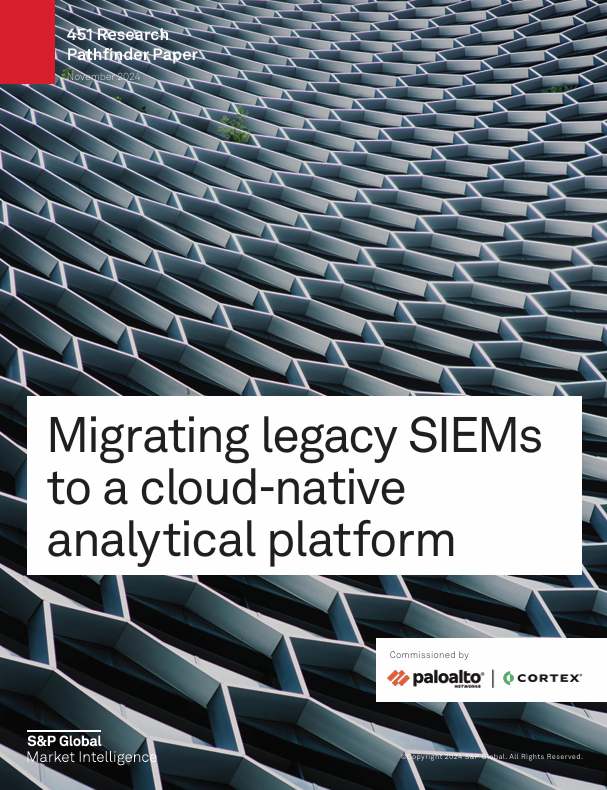
451 RESEARCH REPORT Navigating from legacy SIEM to modern SecOps. Data-backed insights on executing cloud-native SOC transformation.
[img width=374]//f3bb08b8efc611081e05f77b02395fcc.cdn.bubble.io/f1786530692387x214651298556034500/richtext_content.png
Actionable steps for planning the move to a cloud-native platform.
Security teams now face a dilemma: Maintain many outdated and disjointed tools, like legacy SIEM, or migrate to a singular SOC platform built for today’s challenging, complex environment.
In this report, 451 Research uncovered that the increasing maturation, prevalence and affordability of cloud-native platforms has led to a global trend of organizations moving toward consolidation. Other insights from the research support this finding, including:
[li indent=0 align=left]72% of respondents have more than one SIEM, and 41% have more than two (mean of 2.4). [li indent=0 align=left]The #1 technology organizations seek to layer on top of SIEM is threat detection and response. [li indent=0 align=left]49% of respondents’ third-party tools and services are designed to work with multicloud environments. Migrating from a legacy SIEM can be complex, particularly in larger organizations. 451 Research recommends that organizations evaluate several factors prior to making the transition.
Explore the full report to learn 15 actionable next steps for planning and executing cloud-native SOC transformation.